The shape of things to come
A brighter future for people and planet

Way back in the dimly-recalled shadows of the 1990’s an inescapable pop song called “Waterfalls” burrowed its way into my brain. Don’t go chasing waterfalls – implored the lyrics – please stick to the rivers and the lakes that you’re used to. My teenaged self took a serious disliking to this exhortation to play life safe: chasing waterfalls sounded like a much better plan. The song is barely remembered now, but the idea stuck so fast that I still think of following big, bold and slightly crazy dreams as “chasing waterfalls”, and lately that’s just what I’ve been doing.

Myrtle Falls, Wellington Park, Tasmania
If you thought perhaps I’d fallen silent because I’d had an attack of good sense and spent the winter relaxing and catching up on sleep, well you mustn’t know me very well. That may have been the sensible path, but this is *me* we’re talking about and if I’m not busy challenging myself and trying to do too many things at once I don’t feel quite properly alive. I’m curious, inquisitive and have a tendency to wander off poking at things that catch my attention.
For the last year or so South America has been a source of inspiration and fascination, particularly the mix of complex sustainability issues and welcoming culture I found in Peru. I came back from my last trip in April with a head full of ideas but no clue as to how to make them reality, so I did what I always do when I lack sufficient data and threw myself into learning how exactly one goes about trying to support sustainability management in a developing country on the other side of the world.
Weekends were spent reading research papers and NGO reports to understand the issues and governance frameworks. Free evenings were swiftly occupied by Google searches for programs and companies doing the sorts of work I was interested in. I enrolled in Spanish classes. I talked to my boss about opportunities for sabbatical leave and worked out how to go about packing up my life to follow a dream. I was all in.
I leapt, and as so often happens when you’re on the right path and making the right choices for all the right reasons, I found my wings on the way down. I have a job, for a year, in Peru, doing sustainability-shaped things!

Dove Canyon, Cradle Mountain – Lake St. Clair National Park, Tasmania.
I’m going to be light on the details to make sure I stay on the safe side of the code of conduct I’ve signed with its strict conditions for social media mentions, but what I can tell you is this:
- It’s a volunteering but with living expensed covered type of gig;
- I’ll be embedded with a Peruvian host organisation, the only foreigner working as part of a small team;
- I’ll be based in Lima and working in a Spanish-speaking environment, which is wonderful and terrifying in almost equal parts;
- I’ll be helping to develop environmental management processes and protocols for sustainable natural resource management for protected areas; and
- I may be lucky enough to visit and work in some of the most biologically diverse places on earth!
I am wonderfully, joyfully excited about it all, and just a little nervous and apprehensive too. Most of all, however, I am busy as I sort out my life and get ready to go.
I’ve got projects to finish at work, and I’m wanting to leave on a high note (especially since they’re letting me come back again) There’s background reading to make sure I’m informed and Spanish study to do, plus epic amounts of paperwork, medical and logistical planning to work through (I’m immune to rabies as of today, which feels like quite an exotic thing to be). There’s the huge job of sifting through my possessions and sorting out what to store, share or sell and still all the inescapable day-to-day work of running my very lovely but rather busy life.
Yes, I’m still harvesting veggies from the backyard (so much broccoli) and cooking myself proper food, still shopping at the market and the local grocer, still cutting more and more plastic out of my life, but I will admit that I catch the bus a little more often than I used to, and drive the car a tiny bit more to save time where I can. I’m not getting as much good sleep and rest as my body tells me I’m needing, and I’m not getting out bush-walking anywhere near enough. Sometimes I really can’t do everything I want to do, no matter how determined or stubborn I am, but I’m still doing ok. I’m still acting in ways that agree with my values, and I’m happy that even when going through such a big upheaval almost all the good changes I’ve made are being maintained. Certainly my learning to do without “stuff” is paying off in spades as I have so much less to pack and store than I did a few years ago: moving 4 times in 5 years really clarifies what you do and don’t need!
What good is material stuff, anyway, when you’re off chasing waterfalls?

Somewhere in the Lares region of the Andes, Cuzco region, Peru.
Adventure called and I answered. I’m off just next month for a year of finding out what I’m really made of, trying to make a meaningful difference to this crazy, beautiful world. A year volunteering in sustainability management in Peru: that’s the shape of things to come!
It is the season of slowness, both internally and externally. The urge is strong to spend my days inside, reading, writing and watching the grey winter days slide by. Outside my windows the garden waits, pleading for love and attention but it’s cold out there, and windy, and the pickings are slim.
I got my winter brassicas in too late, after a bout of wild weather destroyed my little plastic greenhouse and the green shoots nestled within. Unseasonal warmth at the start of winter confused things: one of the apple trees attempted to flower and the potatoes I missed in the harvest sent up floats of green leaves just in time for the frosts. My leeks, beets and carrots failed to germinate (I suspect the blackbirds). The kale, my winter staple, got powdery mildew while I was away and hasn’t really recovered. Dandelions will be a bigger part of my diet this winter than the last…
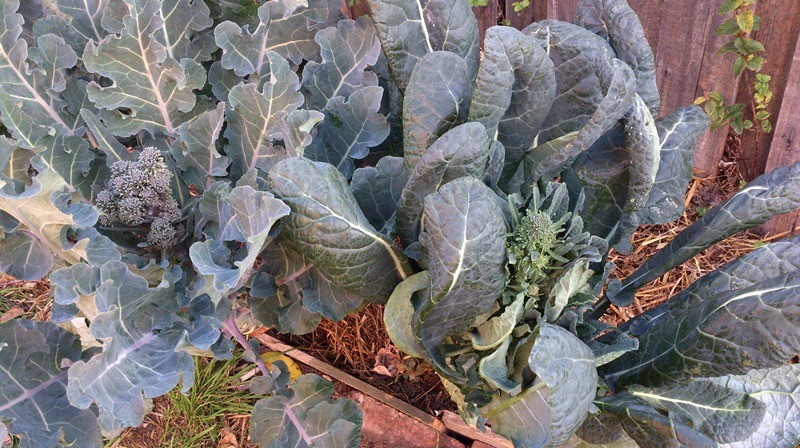
Purple sprouting broccoli on left, surprise tasty broccoli-kale hybrid on right.
I have rocket though, and a small but steady supply of sprouting broccoli. The salad burnet just keeps on giving and makes a nice mix with nasturtium leaves and the tender shoots of the sweet peas that came up in the warmth. The tatsoi in pots is slow-growing but tasty: the plants in the garden perform better but I have competition for the harvest from the brown rats that have set up home in the neighbour’s wood-heap. Too smart for their own good, they ignore the baits the neighbours have laid and the tasty morsels I place in my big steel trap (I have ethical issues with using poisons: I don’t think anything deserves that kind of horrible death or the chance of such nasty things getting into the food chain). Strange rats, they prefer to graze on my vegetables and decimated my winter lettuce crop.
I had to get the oca in a little early after they discovered the tasty tubers and started nibbling. Some things I’m not prepared to share. Now I have 2.5 kg of this delicious Andean staple to keep me going through the cold months, and just as well, since the June warm weather sent my stored potatoes sprouting despite dark storage. Not a bad effort for a new-to-me crop, grown from a half-dozen donated tubers thrown into a hastily-dug garden bed and largely neglected for nine months. I like plants that grow themselves.
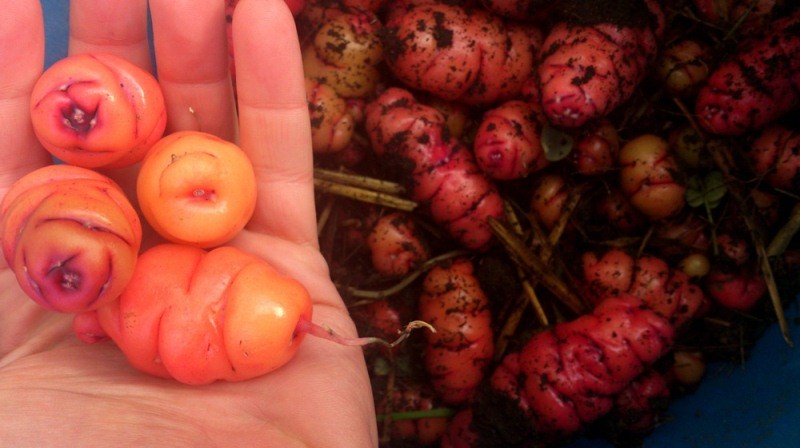
2.5 kg of oca (Oxalis tuberosa)? That’s yam-tastic!
I did motivate myself a couple of weekends ago to re-edge the garden beds in an attempt to keep the grass out and the mulch in (as much as possible when there are blackbirds…) and was pleased to discover that, for the most, the soil was in good condition, rich in humic matter, retaining moisture and alive with worms and insects. Given the dry, compacted wormless dirt that was here on my arrival I’m pretty happy with the improvement. It’s amazing what lazy composting, liberal applications of manure and enthusiastic mulching can do!
Mostly though, I like to sit at my table, taking my time over a pot of tea, looking out over the winter landscape and watching the birds. There are crescent honey-eaters in the banksia hanging over the fence, and they sit on the house wire, chirruping their cheery call, “Eegypt! Eegypt!”. The little friarbirds are a rarer visitor during the cold months, but I sometimes see them perched high, surveying the scene. Flocks of cockatoos wheel way up overhead in the afternoons, on their way across the river to roost. Some winter days flocks of silver-eyes flit among the brassicas, feasting on the aphids in a rush of tiny feathers.
On cold, clear mornings, fog glides down the river as the sun rises. On clouded afternoons the sunset paints pale pastels across the sky, and on crisp winter nights the stars shine ever so bright as I peek out through the curtains, the cottage warmed by the wood heater. Best of all, though, are the days when the raindrops ping and trace patterns across the glass, when I can stay inside, reading or writing and drinking my tea without any guilt, knowing that nature is providing exactly what my garden, and I, need right now.
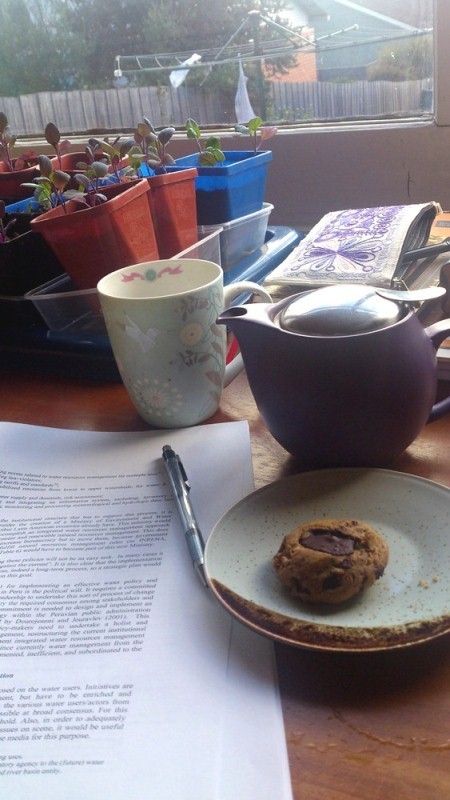
Ahh…

There’s no road map to the path I’m forging. No one’s footprints to follow, only my own uneven tread.
Progress is more of a spiral than a straight line: a slide backwards reminding me of why I need to keep pushing forward, a stumble another lesson (re)learnt.
What matters is to keep on walking.
Seeds: they are amazing. That these tiny things hold within themselves the complete potential for an enormous tree, beautiful flower or delicious vegetable is a wonder of nature and evolution.
That anyone can harvest a seed, plant it, and grow plants to feed themselves is an extraordinarily beautiful thing. Seeds are part of our heritage, our culture, our civilisation. Without the ability to cultivate plants from seed we’d never have formed agricultural societies, and without agricultural society you would not be reading this.
Seeds are integral to what it means to be a modern human; to how we feed ourselves, how we structure our societies, how we manage our land and other natural resources. Such tiny things are so critical to who we are and how we live.
Seeds are important, and they are under threat.

Loopy legislation
I’ve written before about how important crop diversity is. Why it matters to grow rare and heirloom vegetables, and to save seed to cultivate plants best suited to local conditions. The maintenance and continual evolution of plant genetic diversity is critical to food security, to making sure we can feed ourselves and future generations.
The science behind this is incontrovertible.
That’s why I was horrified to find out about the proposed EU regulation “On the production and making available on the market of plant reproductive material” (aka the Plant Reproductive Material Law). Under the legislation[1], any seeds sold commercially must:
- belong to an acceptable variety or clone that has been registered with the UN;
- comply with the specific requirements adopted for the marketing category of that plant; and
- comply with legislated labelling, handling, certification and identification requirements.
i.e. for an annual fee and a pile of paperwork, you can be permitted to sell your seeds. Maybe. If the government decides your plants meet the registered “definition” for that variety.
What does a plant definition mean anyway? That means the seeds can’t show much genetic deviation from the registered type specimen for that variety, retarding development of strains and varieties that suit local conditions. That means restricting genetic diversity and increasing susceptibility to disease and climatic changes.
Although these laws don’t apply to backyard gardeners like me, they do apply to anyone in the EU who grows plants or distributes seeds for commercial sale. That includes your market stall holder, local nursery, native plant suppliers and market gardeners[2].
Why does this bother me? Because we’re letting politicians decide what constitutes a valid variety of food plant; because we’re stifling innovation and local adaptation, and at the same time reducing plant diversity; because the law gives advantage to large corporations who can manage the administrative imposts and pay the registrations, not to mention lobby governments over the very definitions of “acceptable varieties”.
Copyrighting life
What sorts of corporations are involved in the business of seeds? Large multinationals like Monsanto, Dupont, Bayer and Syngenta: not exactly model corporate citizens (seriously, read the links).
Companies with have a track record of patenting plant genomes (making a food crop somehow “copyright”) and taking farmers to court who accidentally sow their seeds[3, 5,6]. Companies that deliberately push genetically modified (GM) crops that cannot be bred by farmers[4], forcing them to continue buying seed from Monsanto every year and preventing the development of new varieties and the adaption to local conditions.
Monsanto alone is alleged to have lodged 144 seed patent infringement lawsuits in the US thus far.[6]
These companies aren’t in the business of protecting biodiversity. They don’t believe fair and free access to seeds is a fundamental principle of human rights. For these corporations, the narrower the range of crops and the less adaptable the plant genetics, the more opportunities they have to make profits by developing and selling copy-righted seeds. If we lose our ability to develop and distribute locally-adapted and unusual varieties, we lose control of our food sources, we lose our ability to develop crops that suit our soils, climate and cultural traditions and grow dependent on the corporations to sell us patented seeds to feed ourselves. Patented seeds the farmer cannot harvest and re-sow, sold for maximum profit, from the narrow range of crops that these companies invest in.
That’s a pretty scary road to be travelling down.

Seedy science
The science of genetically modifying, or engineering, plant materials forms part and parcel of the debate about seeds. GM science gets all caught up in the politics and corporate sociopathy, but it’s vital to examine the science in its own right. The science of GM is neither good nor evil; it’s how it’s applied that determines that.
GM: genetically modified. What does that mean? It means humans have messed around with a plants genome, the DNA that codes how that plant grows, what nutrients it has, how sensitive it is to chemicals, how tolerant of certain conditions. The genome that is copied into a plant’s reproductive materials: its seeds. The agri-corporations are using GM science to develop plants that are resistant to specific herbicides, usually owned by the same company, like Monsanto’s Round-up and their GM “Roundup Ready” seeds.
GM science can also be used to develop crop strains that can be grown in new areas, places too dry, too wet, or with soil too poor to grow traditionally-bred varieties. It can be used to reduce reliance on fertilizers, herbicides and pesticides, to increase crop yields, to improve nutrition and to develop plant resistance to famine-causing diseases.[4,7] The scientists working on GM foods are doing so because they see the science as a powerful tool for helping to feed a growing global population in an uncertain future, and maybe there’s a place for GM in the world-feeding toolbox. There’s just not when it’s in the hands of vested interests.
GM’s still a relatively new science too, and we’re not sure what the long term effects of GM foods might be. That doesn’t mean we shouldn’t work on the science though: it means we should be cautious and make sure the long-term studies and trials are done before we leap into GM cropping. That’s not what’s happening though, with the agri-corps pressuring government to permit GM seeds on the market before these (costly, long-term) studies are done. GM might not be evil, but right now there are a lot of good arguments for caution and maintaining large agricultural areas that are completely areas GM-free.
So what does all this mean?
To me, all of this shows how important it is that the community is informed, aware and involved in the business and politics of seeds. It’s too big an issue to leave to the lobby groups and politicians: all of our futures are caught up in the incredible potential of seeds.
Concerned? Take the time to get informed and make sure your voice gets heard.
I’m keeping an eye on the EU legislation and have signed the international petitions against the proposed EU legislation here (AVAAZ) and here (Noah’s Ark Foundation).
I’m also paying attention to the discussions happening here in Australia around GM crops, agribusiness and associated legislation. Here in Tasmania our temporary ban on GM crops is due to expire next year[8], and there’s good reason to get involved in local action campaigning for a renewal.
Seeds belong to all of us. It is critical to the future of humanity that this remains the case: that we can breed, grow and freely trade the food plants that best suit our climates, cultures and local conditions to ensure a future where we’re all well fed.

[1] The European Commission (2013) Proposal for a regulation of the European Parliament and of the Council – On the production and making available on the market of plant reproductive material (plant reproductive material law); European Commission, Brussels.
[2] Rabesandratana T (2003) Overhaul of E.U. Seed Regulations Triggers Protests; Science magazine; American Association for the Advancement of Science.
[3] Cornell University Law School (2013) Vernon Hugh Bowman v. Monsanto Company in first sale doctrine patent exhaustion infringement; Legal Information Institute, Cornell University.
[4] Kruft D (2001) Impacts of Genetically-Modified Crops and Seeds on Farmers; The Agricultural Law Resource and Reference Center, Pennsylvania State University.
[5] Wikipedia: Monsanto Canada Inc. vs Schmeiser.
[6] Tepper R (2013) Seed Giants Sue U.S. Farmers Over Genetically Modified Seed Patents In Shocking Numbers: Report, Huffington Post, TheHuffingtonPost.com Inc.
[7] Walsh B (2013) Modifying the Endless Debate Over Genetically Modified Crops; Time Science & Space, Time Inc.
[8] DPIPWE (2009) Policy Statement: Gene technology and Tasmanian Primary Industries 2009-2014; Policy Division, Department of Primary Industries, Parks, Water and Environment, Tasmanian Government.
I’ve been working on a serious post on seed legislation, GM crops and sustainability, but it’s going to take me a little longer to finish. I’m struggling to find time to research the issue thoroughly and I really want to make sure I’m properly informed. In the meantime, here’s something I wrote a little while ago and didn’t get around to posting. Hopefully I’ll have some science-based content ready for you soon! T.
***
Recently I realised, really properly realised, that my life is completely dependent on modern technological society.
It’s something I’ve been aware of, to some extent, but it’s only now that it’s really clicked how total that dependency is. I’m not talking the small stuff, like how I derive my income, clothe myself and support my lifestyle. I’m not talking about the medium stuff, like my dependence on modern agriculture, transport, water and sanitation systems. Yes, if those systems collapsed right now I’d be in a lot of strife. Our society would fail and life would be extremely different and difficult, but it wouldn’t kill me. The loss of modern medicine? That would.
I am medication-dependent. I have no thyroid gland. We killed mine, modern medicine and I, bombarding it with radiation until my ability to regulate my own metabolism was no more. There was nothing wrong with my thyroid, per se. We killed it because we couldn’t find a way to stop my immune system from attacking it, and with a rogue immune response on the rampage I was pretty sick and would eventually get terminally so or go into thyroid burn-out anyway.
I am medication-dependent. My life depends on the technological-industrial machine. Somewhere they make synthetic thyroid hormone, press it into tablets and pack it into blister-packs of 100 doses. From that somewhere they ship it great distances to my local pharmacy, where it finds its way to me. They need to be refrigerated, my little life pills, as the hormone starts breaking down after two weeks at ambient temperatures.
I am medication-dependent. I need access to a doctor who understands my ailment. I need routine blood tests to confirm my synthetic dose. I need international freight, aluminium blister packaging and refrigeration just to survive. That means I need the mining, mineral processing, manufacturing, petroleum, transport, refrigeration, pharmaceutical and health-care industries so that I can stay alive. I am completely dependent on the system, and that’s a very sobering thought indeed.
If I go off-grid, I get sick and I die.
How many of us are there? Every person with a thyroid condition, with insulin-dependent diabetes, with rheumatoid arthritis or one of hundreds of other non-terminal-if-treated conditions. Millions of us, all dependent on the technological-industrial complex to keep our bodies functioning, to stay alive.
Today I was seriously thinking about my future, about where I want to go, what I want to do with this one precious shot at life. I want to change the world, but at the same time I have to live within it. I could choose to reject this modern technological society, to live outside it, truly sustainably and free, but to do so would, ironically, be choosing to die.
A grim choice, indeed, but one I’m lucky to even be able to make because I had the good fortune to be born here, in the turn-of-the-century developed world. I got sick and modern medicine took care of me. For how many others is there no choice at all? No access to the life-saving interventions and drugs we rarely stop to consider? It’s making me stop and really think about what a human life is worth versus the value of our planet and the ecosystems that support the whole 7 billion (and rising) of us. Is it justified, this environmentally-costly medical intervention? I’m certainly very happy to be alive and in good health, and being aware of just how tenuous good health can be, has driven me to make the most of the time I have here, to try to leave the world in a better state, but is my life really worth it? Am I worth the sum of my impacts? Is caring for the sick environmentally sound?
Whatever the answers, I know I’m incredibly privileged to be here, to have the machine on my side. I’m forever grateful to my doctors and for everything that goes into these little white pills that keep me alive. I can’t opt out of the machine now, my life is tied to it, but I can choose what I do with this life. I’m lucky to be here, the least I can do is try to make the world a better place, not just for me, but for everyone.

I have slowly been getting my life back in order and recovering from a little souvenir illness I brought back from Peru. After so many weeks away or otherwise indisposed I feel like the world has got away from me a little.
Still, the list of things to do is – very slowly – getting shorter, as are the days. Although it’s technically still autumn, winter arrived here in Hobart a few days ago. I’ve been enjoying the frosty mornings, cold blue-sky days and crisp, starry nights. Having the wood heater going really does help with enjoying the cooler weather, I must admit, and I’ve purchased another load of ‘sustainably-harvested’ firewood.
Meanwhile there’s always work to be done in the garden, no matter the time of year. I’ve harvested the last of the beans, tomatoes and potatoes, plus the surprise Jerusalem artichokes (thank-you former tenants). While I was gone the lettuce went to seed, so at some point I need to dig the seedlings out of the lawn and find a better place for them. The winter brassicas are coming along nicely too, with staggered plantings of broccoli, kale, cauliflower, Brussel’s sprouts and tatsoi to get me through the coming months.
Really though I’m looking forward to the slower pace of winter; to quiet nights in front of the fire, slow cooked meals, sleeping in and time spent with good books. The challenge now is making that happen, with everything else I want to do, and still finding time to research and write.
Somehow, though, I always find time to stop and appreciate the beautiful world around me.

What do you like best about winter? Tell me how you celebrate the cold season.
When is a holiday not a holiday? When it involves working and studying and throwing yourself head-first into a foreign culture and totally different economic reality.
People keep asking me how my ‘holiday’ in Peru went, and look confused when I answer that it was difficult, challenging and one of the hardest things I’ve ever done. ‘But surely it was amazing?’ they ask, and it was but it was also very confronting and exhausting and demoralising at times.
I wasn’t on holidays.
I went to Peru for a month of Spanish school and volunteer work in Cusco, to reality-check an idea born of my first trip there, last year, as a tourist. An idea of living and working in Peru in sustainability management, doing something a little more hands-on to make the world a better place. Through a series of logistical dramas and local connections, I also wound up spending the month living like a working class Peruano, which certainly increased the reality value of my experience!
I spent a month dreaming of real hot water, cooking facilities, heating and having a place that was hygienically clean! A detailed post on living conditions and the reality most Peruanos face will hopefully be forthcoming, but for now let’s just say it’s not easy, and I was living in relatively cosy conditions compared to many.

My neighbourhood, just outside of tourist Cusco, on the edge of another world.
There’s also a post coming about my volunteer project, and the frustrations, obstacles and immense rewards to be found in working with communities to teach sustainability and environmental management skills and try to create real, meaningful change. I learnt a lot about learned helplessness, poverty tourism, charitable entitlement and the disaster that results when external agencies try to impose their ideas of what help, resources and structures the local community needs. I didn’t achieve anything like what I set out to, but I learnt an awful lot!
Of course, spending a month entirely immersed in a foreign culture and a different language is always hard work. My Spanish may be good enough to get by in most day-to-day interactions, but not getting a rest from it was exhausting. For three weeks I started each week day with 4 hours of grammar and conversation lessons before grabbing a quick lunch and spending the afternoon trying to teach gardening and organise resources, all in Spanish. I hadn’t realised how specific the language of gardening was until I started trying to explain basic concepts like soil preparation in a different tongue! Then it was a trip home on the bus, dinner in a local cheap eatery and Spanish homework, perhaps with a catch-up with a Cusqueñan friend thrown in. All Spanish, all day, every day.
I regularly found myself appalled by the pollution and social conditions, ethically challenged by the behaviour of other well-intentioned foreigners, frustrated by language limitations, mentally exhausted at the end of each day and longing for that unobtainable proper hot shower…

The mish-mash of Spanish and Quechua cultures, of modernity and antiquity give Cusco it’s charm but also pose complex challenges!
The trip wasn’t easy for all those reasons, and yet none of these are the main reasons I found myself struggling and questioning if I could really do this. The thing I found hardest was finding myself completely isolated from other people who share my values and the systems that support those values:
- How do you cultivate sustainable change within a culture that does not value the environment, where the overwhelming majority of people drop their rubbish wherever they are, city, country or internationally-significant heritage area?
- How do you start the conversation with people who don’t know what ‘environmental’ means, who don’t understand the impacts of pollution and don’t see the problem?
- How do you talk about the importance of choices when working with people who have been so historically disempowered, and still are under the modern political system, that they don’t believe they can change anything?
- How do you engage a people so scientifically illiterate and under-educated that they have no basic awareness of the links between environment, pollution, agriculture, nutrition and health?
- How to you empower people in a political system that is hopelessly, endemically corrupt and self-serving, where there is no social shame in exploiting the poor and the poorly-educated?
- How do you create awareness and concern for the environment when even those who get it are more concerned about how they’re going to keep feeding themselves or the family, or the dire consequences of speaking out and irritating the wrong person?
- How do you keep yourself going when you’re completely on your own, in a strange country, a foreign culture, outside of your own language, social networks and support structures?

Water quality, water access, de-forestation, soil management, social inequality, absence of infrastructure, corrupt government and the impacts of tourism are just some of the sustainability issues impacting on rural communities in Peru.
For a month this was my reality and I really struggled with it. The problems seem so vast, so endemic and so unsurmountable I wondered if it was all a foolish idea born of naivety and idealism, was there really anything I could do? Then there were the break-throughs:
- The moments when I actually worked out how to accomplish something and the feeling of achievement that came with it.
- The realisations that I’d succeeded in teaching someone something that has the potential to alter their future.
- The ripples of change as one person’s changed perspective and awareness was passed on to another.
- The growing understanding of how to work with people, to be a catalyst for change or knowledge they were seeking, rather than imposing my own ideas or methods.
- Realising that a lesson or experience so small to me as to be insignificant was enough to make a genuine difference to someone there.
- Ground-testing my ideas and realising that my odd set of skills and experience gives me a distinct advantage in succeeding, so long as I get my Spanish (and then Quechua) up to speed.
- Meeting an amazing array of people from different backgrounds, cultures and experiences who saw something in me and offered me the gift of belief in my ability to make something of my dream.
- Beginning to see the ways in which I could actually change things, in small, manageable ways that have the potential to grow and sow real, sustainable improvements.
I wasn’t on holidays. I was busy testing everything I believed about the world and my place in it, about fairness, about universal values, about social equality, about the basic goodness of human beings. I was busy learning difficult lessons about who I am, what I can and should tolerate, where my limits are, and how strong and brave I can be. I spent a lot of time reminding myself to be like bamboo: strong yet flexible, bending with the forces around me yet retaining my true shape.
I went looking for a way to change the world. I learnt there is no easy way, that what I’m thinking of doing is incredibly hard and challenges me on so many levels. I learnt that more than changing the world I end up changing myself. Yet I also learnt that there is a desperate need for environmental education and advocacy in the developing world, that I have a valuable skill set and that I can make a useful contribution if I play my hand well. I can see opportunities to make a real difference to a handful of lives, and I understand that small changes ripple outwards to become much bigger. I learnt that I have a gift for finding and connecting people, no matter where I am, and that even when I’m feeling worn out, discouraged and full of doubt other people still see a contagious passion and energy in me.
I still don’t know if I’m strong enough or brave enough to make a go of it, but I do know that I’m reckless and optimistic enough to try.
Home again. Hopefully normal blog service will resume shortly, but in the meantime, here’s a little something from my travels…

In the greenhouse at the Girl’s Home where I was volunteering, trying to teach food growing skills.

Cusco, home base for my month-long stay.

In the hills above Cusco, learning about Peru, her people and culture.

Stumbling across human history in the spectacular landscape of the Sacred Valley in Pisac.
It was a very intense trip, challenging on many levels. It’s given me a whole lot to think about, but for now I need to focus on unpacking and getting my life back in order here in Hobart.
Meanwhile, how have you been?
This is going to be a far shorter post than I want it to be. I want to do my research and give you the numbers but I don’t have the time. I leave the country in just a few days, and writing for the blog has kept falling off my “must get done” list. I’m sorry. I’m not going to do these guys justice, and I’m going to fall silent again. Life is short and I’m busy living it, but I have so much I want to say. So, on with it!
I’ve written before about unusual and heirloom vegetables and the importance of maintaining a diversity of seed to enable us to grow crops that best suit our local conditions, that provide the quality or yield of food we seek and provide a rich genetic pool to draw on into the future. Crop diversity helps us to make best use of the land and resources we have, and to adapt to changing conditions as the climate shifts. Protecting plant diversity is important work, and seed banks around the world are contributing to it. It’s not only plant diversity that matters though: if we’re going to feed and clothe ourselves as best as we can, agricultural animal diversity matters just as much. Rare breed beasties need loving too.
Farming systems have become industrialised and standardised across much of the world. Just like crops, the animal breeds most commonly grown are those that give the greatest yield per unit cost, with little consideration given to animal health and welfare, suitability for conditions, environmental impacts, disease resistance or even quality of flavour. Much like supermarket tomatoes, many farmers are growing flavourless meat. For instance, a modern meat chicken takes as little as 30 days to raise from egg to plate1. From nothing to roast dinner in a month? That’s crazy selective breeding for yield and little else.
You may shrug and think that a pig-is-a-pig-is-a-pig, but as such farming practices spread and traditional livestock breeds are replaced by the fast-growing, so much genetic heritage, so much biodiversity, is lost. Along with that we’re losing cultural heritage: breeds that are markers of places or peoples, farming practices that are tied deeply to ways of life. All that is gone, left to fading memories, as heritage porkers are replaced by Large Whites2.

Rare breed livestock (and Cyril) at Mount Gnomon Farm.
That’s the serious side of things – lost diversity, resilience and heritage – but we’re also losing flavour. Industrialised farming doesn’t grow for best taste. The aim is not the highest quality, merely consistency at a low market price. Does taste matter? Not to everyone, not to those on tight budgets, but to you and me? Sure does! One taste of proper free-range piggy ham from a breed grown for taste convinced me enough that I had to try the bacon, then the chorizo, just to be sure… I didn’t know pork could taste so good!
Lucky for me I live somewhere where I can buy free-range raised, rare breed meats. I can do this because where I live there are farmers who are passionate about rearing rare breeds and keeping all that heritage alive. Farmers who put animal welfare, product quality and taste above maximising products and have worked hard to build up enough of a market that they can grow businesses outside the cut-price supermarket paradigm. And yeah, I’m lucky that I’m in a position where I can choose to support them: I don’t eat much meat, but what I do eat, I can afford to source from these types of farmers. These farmers, who have become people I know.
Let me introduce you to two of them: Guy and Eliza from Mount Gnomon Farm. These are the folk who awakened me to the true beauty of bacon, grown from their drove of Wessex Saddleback pigs. They are fierce supporters of preserving rare breeds and choose their livestock based on an ethos of preserving rarity, suitability to farm conditions, animal well-being and quality of flavour. They are also truly lovely people, and last year I was lucky enough to visit them on the farm and see their passion in action. It’s a beautiful spot on the edge of the Dial Ranges in northern Tasmania, all green grass, red soil and dramatic sky. I’m very glad I had the chance to visit, to meet my meat and learn about the challenges and rewards of free-range rare-breed farming.

While I’m happy to pat a cute little piggy, I think I’ll leave the big guys to brave Eliza!
It was an inspiring trip for this sustainable eater, and one that you too can make if you’re going to be in Tasmania this weekend. You see, Guy and Eliza are so dedicated to what they do that this weekend they’re opening up the farm to the public to share their passion and show anyone who wants to know how their meat is raised. This Sunday (March 24th) they’re inviting you to a Rare Day Out at Mount Gnomon Farm.
You can visit the farm, get up close and personal with the animals, see what they’re doing to protect the soils and support on-farm diversity and even sample the very tasty meats their animals become. If you’re interested in heritage breeds or free-range farming, or just getting to know a little bit more about where your food comes from, I highly recommend you go along and check it out, and while you’re there, give Cyril a good scratch for me…

Why won’t I be there? because I’ll be on my way to Peru! Catch you in a month or so and as always, thank you for reading!
[1] “The first harvest might occur as early as 30-35 days and the last at 55-60 days.” Australian Chicken Meat Federation Inc.
[2] “The Large White has become well established as a major breed in virtually all pig producing countries in the world.” NSW Department of Primary Industries.
It’s that time of year again. The days are still hot, the soil still concerningly dry and the breeze still smells of smoke but they are getting shorter. Summer is slowly sliding into autumn.
The garden knows it. The leaves on the last potatoes have been yellowing. The beans, so prolific this summer, are finishing. A lone pumpkin is beginning to ripen on the self-sown vine. The red winter kale has finally admitted defeat in the face of powdery mildew and aphid attacks and gone to seed. Summer’s bounty is fading.
It’s been an odd growing season, and my first summer here at the Cottage. It was exceedingly hot1 and dry,2 with horrible winds that stripped the moisture out of everything. I don’t like to water much, but even my well-mulched, water-conservative garden has needed a good weekly soaking. The eggplants and chillies enjoyed the heat and I’m looking forward to harvesting a handful of aubergines. The tomatoes haven’t done so well though, or the zucchini: where I was expecting great gluts I’ve ended up scavenging from friends to gather enough for preserving. Still, I’ve had plenty to eat and largely kept myself in veg this summer (with the notable exception of carrots, of which I grew just one).

As the season progressed, so did my weekly harvest!
Now it’s time to prepare the garden for autumn and to stock my stores with the excesses of the summer. Yes, it’s relish time again!
The over-ripe tomatoes I scavenged from a friend’s garden have been turned into jars of rich, summer flavour. Soon that same friend’s surplus giant zucchinis will be cooked up with Indian spices for a spicy savoury relish. A couple of kilos worth of beans – green and scarlet runner – have been chopped and blanched and bagged up in the freezer for winter meals to come, and rhubarb has been stewed and frozen for winter porridge breakfasts. The apples that survived to worst of the weather only to fall prey to codling moth have had the edible parts rescued, been poached in vanilla syrup and stowed away: a delicious sweet treat despite the beasties. A good three kilos of potatoes are paper-wrapped and await a dark place to be stored.
It’s time, now, to prepare the garden for my winter crops. There are beds to dig, seeds to be sown, and if I don’t do it now there will be no backyard harvest through the cooler months. The soil needs a lot of love in places before much of anything will grow, so the compost bin has been shifted and I’m prepping green manure to get some much-needed organics worked in. One over-worked bed will lie fallow this season, then be planted out with herbs come spring.
For now, though, it’s autumn and winter veg I’m thinking of. I have interesting new heirloom seeds to sow: golden beets, fractal (romanesco) broccoli, ruby sprouts, mammoth leeks and purple cauliflower. Poor little plants will need to fend for themselves though, as soon I’m heading overseas again for a while. I’m relying on the kindness of friends and neighbours, on my little community, to tend my garden while I’m gone.
That’s the magic of a garden though: it doesn’t just grow food, it grows connections.3 This summer my surpluses have been shared with others. I’ve traded beans and potatoes for apricots and nectarines. I’ve swapped seeds with other growers. I was given the most amazing types of tomatoes by Pauline Mak and traded garden pest info with Provenance Growers.
My garden does so much more than feeding and nourishing me: it feeds the bees, provides home for the birds, it binds and enriches the fine black soil and it creates places for all sorts of crawlies to scuttle about. It creates a topic of conversation with friends and strangers alike, and allows the free trade of information and sharing of experience. It supports simple acts of giving and sharing and, like the sunflowers blooming down the bottom, spreads a little beauty through the world.
This is what my garden grows.

What about you? What’s happening in your patch right now? Are you starting spring planting? Still awaiting the thaw? Or, like my parents up in south-east Queensland, waiting for the saturated soils to dry out enough to plant?
What do you love about your garden? Tell me, what does it grow?
[1] Records were set for the hottest single day (41.8oC), the hottest summer overall (highest mean summer maximum) and the number of days above 30oC – source: Bureau of Meteorology.
[2] Only 39% of our average summer rainfall fell – source: Bureau of Meteorology.
[3] The social benefits of a garden – source: Irish Food Board.
 The shape of things to come