The shape of things to come
A brighter future for people and planet

It’s about to get quiet around here: very quiet indeed. I’m taking a break from this blogging business while the rest of my life needs my focus.
It’s not that I don’t want to be writing: I do! I have a huge list of blog topics up on my wall, several half-written posts in my head and a few more sitting in the drafts folder. It’s not a lack of motivation or a shortage of ideas. What I am running low on is time.


How can doing things like this not inspire me?
I’m working long hours and travelling a lot at the moment and lots of long days are taking their toll (On the plus side I’m getting lots of practice at packing and living out of my backpack, which will be handy for my upcoming South America trip!). I’ve been too busy to get out bushwalking or go drumming. I’m running on coffee, sugar and stress.
It’s not a sustainable way to live, and so I’m stepping back a little while I get through this busy period and while I’m off on adventures overseas. A sabbatical: time to reflect, explore new ideas, go on a grand adventure and get my life back into balance. Two months off.
I’ll be back again in September to share my stories from the road and keep growing this little community. In the meantime, here are a few great reads to keep the conversation going:
Blissful blogs:
- Whole Larder Love: let Rohan’s excellent photography and delicious recipes inspire a low-impact lifestyle
- Speed River Journal: my Canadian friend Van blogs about his own sustainability journey
- Provincial Life: the lovely Kat explores Tasmanian food and places with an eye on reducing her environmental impacts
- Milkwood Farm: adventures in establishing a viable permaculture venture
Noteworthy news:
- Grist.org: Environmental news, views and advice
- ABC environment: Australian environmental news and information
- Science Daily: sustainability news from around the globe
A touch of zen:
- Zen Pencils: gorgeous weekly illustrations of great quotes to inspire you

Open mind, open heart, open road
It’s fitting that I’ll be posting again come the start of spring. It’s a good time for re-beginning.
See you in September!

Starfish, Lady Bay, Tasmania.
Hang in there, you’ll make it through.
Emma is a food blogger, former registered nurse and perennial uni student, living in Brisbane, Australia who loves taking photos of just about anything. She blogs about food and shares things that inspire her at www.asplashofvanilla.com and has kindly agreed to share her vision of the shape of things to come.
Huge thanks to Emma for joining the conversation. Guest contributors are most welcome!
***
Toni has very kindly asked me to do a guest post on what sustainability means to me and the kind of future I’d like to build so I hope I can do her justice. I’m afraid I don’t have any definitive ideas though; this is mainly just the way I try to make my way through the world.
Growing up, I had an unconventional childhood in northern NSW living on a hobby farm. I’m influenced by my upbringing in that I’m passionate about healthy, ethical food and living however am conflicted by my city living, modern lifestyle and often struggle with that. I love tea and books, will never buy an eBook reader and also, apparently I’m a resister (those who don’t use Facebook) which I think is quite funny.

The definition of sustainability seems simple enough when you read it: maintaining our present human, social and environmental needs while making sure we plan for future generations. As most of us know, it’s actually hugely complex and depends on where you live in the world, in your local community and your financial and social capabilities.
We’re living in some crazy times currently and in the western world we’re inundated with massive amounts of information and research studies all conflicting with each other – is sugar a toxin; should we eat meat; is coffee healthy or not; do we over screen for medical conditions and is this harmful or beneficial – are just a handful of issues which plague me. And I don’t know about anyone else but grocery shopping has become a minefield of ethical, health and social considerations – do I buy the Coles-brand organic tinned tomatoes or the Australian company, non organic, low BPA tinned tomatoes? Aaaargh. *Head implode*
To me personally, sustainability means living a simpler, more thoughtful life and here are some things I do:
- Buy produce from local greengrocers and organic online sources;
- Use more traditional methods of cooking and less appliances;
- Sometimes buy treats like coffee or chocolate from fair trade sources;
- Use old appliances until they break down before buying a new one;
- Grow herbs and flowers – it’s cheap, satisfying, healthy and helps us all breathe a bit easier;
- Be kind to each other;
- Understand that not everybody can afford to buy fancy organic food – I can’t stand the middle-class self righteousness regarding healthy, ethical living (OMG you have to eat goji berries, no wait this week its purple carrots). If you have a bunch of kids to raise or a lower paying job then you do the best you can – better your kids eat cage eggs and tinned baked beans as part of a healthy diet than eat junk food. Plus, lower paid workers are often the hardest working – aged care nurses, cleaners, child care workers, carers, gardeners; yet they are contributing hugely to the world we live in;
- Walk where you can;
- Buy and restore old or second-hand furniture;
- Use natural substances like cheap vinegar for cleaning;
- Use your local parks and gardens – we use our local park and it’s mostly empty! If we don’t use them, the council will tear them down and put up a multi storey car park or something;
- Don’t feel bad for liking nice things – having a hot shower and spraying on some perfume can lift my spirits more than anything, as can a nice cold glass of wine or a piece of cheesecake or going out to dinner. Everyone needs these things sometimes; it’s called quality of life!
I’d like to see a future where people still care about where they, and the world they live in, came from. It saddens me that we won’t have libraries one day, that iPhones and iPads are taking over the world and people aren’t communicating like they used to. It bothers me that people want what everyone else has: it’s a bit cultish to blindly do what everyone else is doing, we should be more evolved than that surely?
In saying that, I am seeing a move back to more traditional ways. For example, there’s a significant film camera revival happening at the moment which I love. Digital photography is wonderful but film is special. I also love that there are still so many people who love books: respect! I hope this continues into other avenues of life.
Thanks for reading and I’m looking forward to hearing other ideas about what you’d like the shape of things to be!
Over the weekend I spent a bit of time in the garden, weeding, composting and mulching. I’m preparing beds for the month ahead, keeping myself motivated through the hard graft (the gardens here are seriously neglected) by daydreaming about the harvests to come. As well as thinking about what will do well in my garden and what I like to eat I’ve been giving a bit of thought to biological and genetic diversity and wondering how my plantings might help to keep rare species and varieties alive. So what’s the problem with food crop diversity? The limited types of plants we grow, and the few varieties (genetic strains) of those plants we do sow. Modern agriculture promotes the growing of only a small sub-sample of possible food plants. The plants grown have been selected over the years for various reasons, including high yields, easy harvesting, long shelf-life, market familiarity and easy processing. As western industrial systems of agriculture have expanded across the world, western crops have moved with them, replacing traditional food plants. We’ve lost awareness of many alternative food plants along with the knowledge of how best to grow them, and along the way we’ve lost access to many of the food plants best suited to growing conditions in many parts of the world, and to the conditions predicted in a climate-change impacted future. 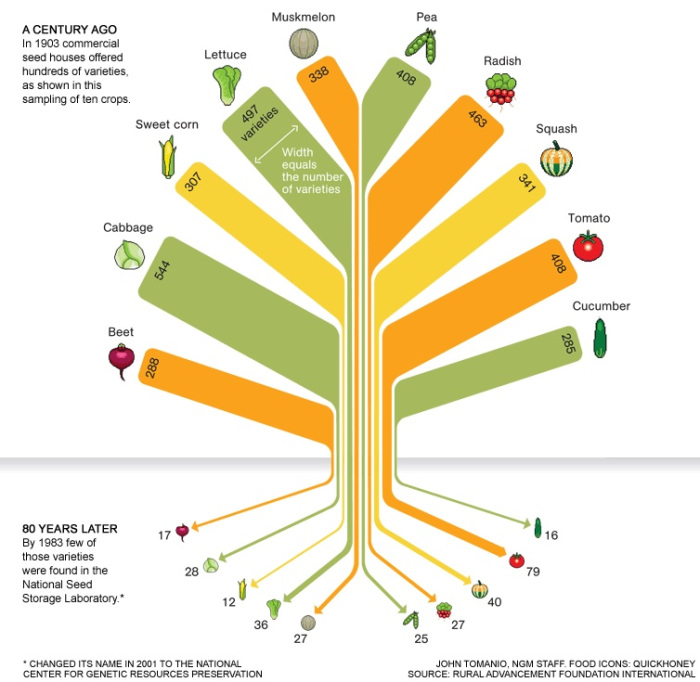 As farming has industrialised we’ve also become reliant on a small handful of the known varieties of the plants that have become our dominant crops. Where a century ago there were 400 known varieties of peas in cultivation, now there’s only 25 that are commonly grown and most of the original 400 have gone extinct. Although it might not seem important – after all we still have peas – this loss of genetic diversity is really quite worrying: genetic diversity is the thing that lets us adapt crops to changing conditions, environments and diseases.[1, 2] If we lose the genes, we lose the means to adapt our food plants to new growing conditions. This is a huge concern for food security[1], putting our agricultural systems at risk of collapse due to drought, climate change, plant diseases and even global politics[2] – agribusiness is big business. The UN’s Food and Agriculture Organisation estimates that 75% of crop biodiversity has been lost from the world’s fields[3] – that’s how big the problem is. Some governments and science organisations are so concerned that they’ve established a secure seed bank to preserve rare seeds as best as possible, behind steel doors in a vault built into a mountain beneath the permafrost in the Arctic circle.[1, 3, 4]

Although it’s not only the lost biodiversity that’s the problem – there’s related issues about fertilizer, pesticide and herbicide use [5], as well as lost potential medicinal and biotechnological properties[6], farming knowledge and cultural traditions – it’s the part that I can do a little something about in my own back yard*. I can plant unusual crops and rare varieties of veggies in my little patch, preserving diversity when I collect seed for the next year and expanding my culinary world at the same time. I’ve taken my day-dreams of fresh greens and home-grown spuds and checked them against growing guides and seed catalogues, getting an idea of what plants and varieties will do well on my fine, claggy soil (I could spend hours looking through seed catalogues, dreaming of gardens that will never be…). I’m choosing for suitability, flavour and biodiversity, tracking down suppliers of unusual, heirloom and organic seeds. There’s a world of weird veg out there that I can’t wait to explore! Backyard-friendly unusual veggies that I’m contemplating growing include salsify, skirret, salad burnet, oca, mizuna and elephant garlic. I’m also planning to plant unusual varieties of more familiar crops:
- blue sapphire potatoes – seriously, purple spuds that are tasty too – What’s not to love?
- Chioggia beetroot – it’s stripey!
- purple sprouting broccoli – I grew this last year and am hooked
- “Caspar” white eggplants – early harvesting, so hopefully I’ll have better luck than I did last summer.
…and whatever else I come across that’s just a little different. I’ll find out what works, save seed from the successes and grow them again next season, slowly selecting the genes that do best right here, creating a garden with a genetic profile that’s all it’s own.

What usual food plants or rare varieties are your favourites? What’s the weirdest edible you’ve ever grown? Know any good sources for heirloom seeds or kooky seedlings? Let us know what makes your garden a little more biodiverse! Sources for seeds or unusual seedlings (Australia):
- www.greenharvest.com.au
- www.southernharvest.com.au
- www.thelostseed.com.au
- www.edenseeds.com.au
- provenancegrowers.blogspot.com.au
In Tasmania and interested in food security? Public lecture: Food Security and Nutrition – The GM Question
- Who? former Chief Scientist of Australia and CSIRO Fellow, Dr Jim Peacock AC
- Where? Stanley Burbury Theatre, University Centre, Sandy Bay campus
- When? 10th July 2012, 6.00 – 7.30 pm
- How? RSVP by email to UTAS.Events@utas.edu.au
References: [1] http://www.croptrust.org. [2] Food and Agriculture Organisation of the United Nations (2010) Crop biodiversity: use it or lose it. [3] Longyearbyen (2012) Banking against Doomsday; The Economist, March 10th, 2012. [4] http://en.wikipedia.org/wiki/Svalbard_Global_Seed_Vault. [5] Altieri MA (1999) The ecological role of biodiversity in agroecosystems; Agriculture, Ecosystems and Environment 74, Pp 19–31; Elsevier. [6] Altieri MA & Merrick LC (1986) Agroecology and in situ conservation of native crop diversity in the third world; Chapter 41 in Wilson EO (1986) Biodiversity, Part 3; National Academy of Sciences, Smithsonian Institution, USA. * I can also do something about it through my grocery shopping, steering clear of the supermarkets for my produce, buying meat from rare-breed livestock and selecting unusual veg from the farmer’s market and local grocer.

Lake Pedder in winter, Tasmania
“What good is the warmth of summer, without the cold of winter to give it sweetness.”
― John Steinbeck
Solstice: from Latin solstitium “point at which the sun seems to stand still,” from sol “sun” + sistere “to come to a stop, make stand still” [1]. The highest or lowest excursion of the sun, relative to the Earth’s celestial equator. [2]
Today marks the winter solstice for us here in the southern hemisphere. The shortest, darkest day of the year. Here in Hobart that means an 8 am sunrise and a 4:30 pm sunset (not counting the few minutes when the sun is supposedly up but is hidden by the hills and mountains surrounding this little city). It’s a day where I’m in the office at dawn and leaving at dusk; a day that means winter.
These days, the solstice is easy to forget: busy, indoor lives and electric lighting mean we pay less attention to the passage of the sun across our skies. In the rush to juggle work, family, chores and hobbies many of us don’t give much thought to the turning of the seasons as this little ball of water and rock wobbles it’s way through space.
Solstice – equinox – solstice – equinox; the pattern of the year, the dates by which the seasons were once measured, times to stop, to reflect on our place in the great planetary dance. Ancient cultures paid a lot of attention to such dates, building temples and tombs that align to the quarterly positions of the sun and marking the dates with ceremonies and celebrations. While we may no longer believe in the death of the Green Man or the Tying of the Sun[3] I think it’s still important to observe the solstices and equinoxes, taking time to connect with the cycle of the seasons and reflect on what they mean to us.

Winter: I exhale, the introverted self prevails. It is time for me to slow my life down, conserving my energies. Time to think a little more and do a little less, reflecting on what the previous summer brought and making plans for the next. It’s the season for planning and preparing for the growth ahead, time to contemplate and dream a little of the shape of things still to come.
As within, so it is without: winter is time to rest the soil in my garden, prepare the soil for spring plantings and plan what I will grow. I’m mulching and composting, feeding the ground, and this weekend (weather permitting) I’ll bury my bulbs to lie dark and dormant until spring warmth provokes them into growth. Rain and time will work their magic, life underground preparing itself for the return of the sun.
I like winter. Having grown up somewhere sub-tropical I find myself enjoying the distinctive change of the seasons. Winter in Tasmania means waking up to the wonder of snow on the Mountain, it means enjoying the sunrise as I walk to work and curling up in front of the fire in the evenings. Winter is time to catch up on the books I’ve been meaning to read, to catch up with friends over a quiet night in and a home-cooked meal, to catch up on sleep and re-energise myself.
I’m ready for the months of cold and dark, for my fallow season. It feels strange, instead, to be busy preparing for a big holiday, to still be busy, no time to reflect.
I like winter. It’s the best time to watch the stars as they glisten, ice-bright.

[1] www.etymologyonline.com
[2] http://en.wikipedia.org/wiki/Solstice
[3] http://en.wikipedia.org/wiki/Winter_solstice
I’m writing this on a Monday – that dread day of the week – telling you that life is beautiful.
Thanks to a weekend with the most excellent company, filled with shared laughter, food and affection, I’m feeling totally in love with life. My perspective is refreshed and I can see quite clearly that my life is amazing.
I look around me and see so many good things: the little cottage that’s become a cozy home, the community of warm and inspiring people I’m connecting with, the astonishing natural beauty of this place (that I get to appreciate every day), the loving and inspiring people I’m fortunate to call friends and the many excellent adventures I’ve had and have yet to come. In a few weeks’ time I’m off on an adventure of a lifetime with one such friend: the Atacama Desert and Machu Picchu (I’m almost imploding with excitement about this!). I have a job I enjoy, working with people I like and respect. I wake up in the mornings and I want to get out of bed, to see what the day brings.
This little corner of the universe is a pretty damn special place to be. This life – my life – is something astonishing. My life is amazing. It wasn’t always so.
Not so long ago, my life looked very different. I was lost, defeated and seriously ill. Disaffected with my career, isolated in a State where I knew no-one and with my life tied to another who was pulling me in the opposite direction to where I needed to be, it was a very different picture indeed.

I was not living my values, I was not listening to my emotions and I was very, very stressed. Every ounce of energy I had was expended running as fast as I could just to stay still. They call stress the silent killer, and they’re really not kidding: I developed severe Grave’s Disease, an auto-immune condition triggered by stress and a latent genetic susceptibility. I lost the best part of 5 years of my life to this illness and I lost my will to fight, instead watching my life slip further and further from where I wanted it to be.
Eventually, after two doses of radio-iodine, my body recovered and I finally found the energy to start re-building my life. It was a long, slow process, filled with challenges and difficult lessons, but it’s brought me to the place I am now, and for that I will be forever grateful.
Being sick was awful. Extracting myself from the unhappy mire that had become my life was one of the hardest choices I’ve ever made, but these experiences helped me to build the life I have today. Worth it? Yes, several times over.

Here are a few of the things I’ve learnt along my journey, and will likely keep re-learning for the rest of my life:
- Life in tenuous, uncertain; the future rarely turns out the way we plan. Stop waiting, stop telling yourself “one day” and start living now.
- If your thought processes seem a little broken or you just can’t keep your head clear, find a good psychologist. Persist until you find one who feels right for you; it’s worth every cent.
- Without risk there is no reward. Taking risks challenges us and makes us grow. Playing safe constrains and cripples us. Put yourself out there.
- Learn to be resilient: build the support structures, emotional strength and coping mechanisms to roll with life’s punches and make the best of it. Fighting things you can’t change is a waste of time and the universe doesn’t give a damn about fairness.
- Stress is your body and brain telling you that something is wrong. Chronic stress is a sign that something is fundamentally off-track in your world. Find it and change it.
- Where you can’t change the circumstance, try changing your perspective. Sometimes looking at things a different way can change your whole world.
- As much as possible, live your values. Work out what they are, then how to build them into your every day: life feels much less like hard slog once you stop fighting yourself.
- Don’t underestimate yourself: you will be amazed at what you can learn / achieve / withstand once you’re making those choices for the right reasons.
- Trust your instincts[1]. Our brains are processing so much more information than we’re consciously aware of and feeding it to us as gut reactions.
- Surround yourself with the kinds of people who bring out the best in you. Choose friends who inspire, motivate and encourage you to be the best version of you. Avoid the people who try to make you less than you want to be.
- Tell the people who matter how you feel. Be honest with them and with yourself, ask for what you need, give what you can and love freely.
- Make mistakes, and forgive others for making them. Remember that everyone deserves a second chance, including you.
- Take good care of yourself: no-one else can do it for you, so it’s up to you to work out what you need and provide it for yourself.

So have I won the war? No, but I have learnt how to win the battles that really count. I still take on too much, get over-stressed and under-slept and let life’s knocks bowl me over now and again. There are many lessons I’m going to need learn repeatedly: the ones about balance, about the warning signs of stress, about taking on too many things and trying to control too much, about security-seeking, risk avoidance and resilience. There will be many times I fall down, sliding back into old, broken thought patterns and behaviours. I will fail again and again and again; that is inevitable. But you know what? That’s not what counts.
What matters is picking yourself up again, dusting yourself off and getting back on that bloody horse, no matter how many times you fall. It’s remembering who you really want to be and putting in the work to get there. It’s about learning from each fall, challenging your behaviours and beliefs and finding a better way forwards, building the shape of things to come. It’s about making change sustainable, and stopping occasionally to look around and see just how far you’ve come.
So who do you want to be?
[1] Unless you’re a woman on the contracetive pill, in which case your instincts may well be broken.

Calvert’s Beach, Tasmania
Take a moment to just breathe.
Forgive me for the short entry today. I’ve spent most of the day proof-reading and correcting a 60-odd page document and my brain is now quite fried.
My fractious state has, however, motivated me to write this entry, which I’ve been thinking about for quite some time: I want to grow the shape of things to come.
It has always been my intention to connect with like-minded people through this blog: to share knowledge and enthusiasm, inspire each other and build something bigger than ourselves. Through multiple voices we can learn and accomplish more than with just me on my virtual soap-box. I want to build an online community, a place to make sustainability a shared conversation, grounded in respect, understanding and factual information, and I’d like your help to make that possible.
I’m pestering other people into writing pieces to share here: guest posts to share specific skills, passions and outlooks and regular contributors to share their own personal journeys.
Together I believe we can grow this place into something quite special: a shared resource to help build the kind of future we’d like to see.
Come and join the conversation!
If you’d like to write a guest post, collaborate, suggest future topics or provide constructive feedback on the blog in general, please leave a comment below or send an email to <shapeofthingstoni@gmail.com>. I’d love to hear from you.

These days I think most everyone who’s interesting in food – from either a taste or a sustainability perspective – has discovered the benefits of shopping at local farmer’s markets*. Fresh, local produce that tastes great and supports the local community: what’s not to love?

Farm Gate Market, every Sunday morning in central Hobart.
There’s a lot of good information out there about the benefits of shopping at your local market and avoiding the supermarket produce aisles:
- The food is fresher, thus packed with more nutrients and will keep fresh for longer.
- You can get a broader range of varieties, bred for flavour and to suit local conditions, rather than shelf-life and supermarket aesthetics.
- You’re supporting smaller farmers who tend to manage their land more sustainably than the big agri-business growers that supply the supermarkets (where often decisions are made too far away from the land).
- You’re supporting the local economy, investing directly into your own community instead of creating profits for multi-national corporations.
- You’re shrinking your carbon footprint by purchasing food that’s locally grown and in season, avoiding energy use for storage and transport.
These are all very good reasons to consider shopping at farmer’s markets (though there are potential down-sides in terms of global food security, affordability and global distribution of wealth, but that’s a complicated discussion for another day) and what originally got me out of bed on a Sunday morning to head down to Farm Gate, but it’s not the main thing that keeps me coming back.
What keeps me supporting my local market is the sense of community this simple activity builds. Sometimes I’ll wander the market with a friend, making new connections as we meet people they know, but often I’m happy to wander alone and strike up conversations as I go, a question about growing techniques or flavour combinations turning into a connection over shared interests. Over time I’ve come to know a few of my favourite stall holders and growers, learning about their businesses and the passions that drive them to produce small-scale, high quality food.

Provenance Growers temp me with a diverse array of grow-your-own edibles to try.
There’s Ross and Matt with their free-range heritage-breed pork products, who have made me finally understand what the fuss over bacon is about. There’s the amazing Paulette of Provenance Growers, with her near-encyclopaedic knowledge of unusual edibles and native herbs who is enabling my ever-expanding herb collection (and her mum, who keeps me happily supplied with finger limes). Mark of the Naked Carrot and grower of tasty micro-veg has a ready smile and says nice things about my photography, and Masaaki Koyama makes the best sushi I’ve ever eaten (and has cooked for Iron Chef Sakai!).

Masaaki makes amazing seasonal sushi from fresh local produce.
Through these talented cooks and growers I’ve learnt more about where my food comes from and the challenges local farmers face. I’ve learnt what to do with broad beans and mizuna, eaten purple spuds and slippery-jack mushrooms and ditched growing parsley for the tastier native sea celery. From the market I’m learning what to sow and harvest each season in my own little patch, when dairy goats produce the best milk and how to cook a cassoulet, but more than that I’m making friends with the people who feed me, connecting a little deeper with my local community.
From the corner store to your favourite café, food has an enormous power to draw people together, and no-where have I found that more strongly illustrated than at the market. These days I look forward to catching up with my favourite market people as much as to the delicious produce I’m going to be bringing home.

Farm Gate Market: bringing Hobart people together and building a more connected community through food.
Have you nurtured a sense of community through food? Got any ideas of how we can connect our communities through food in places without farmer’s markets or where socio-economic drivers keep people away? I’d love to hear about community gardens, co-ops and other projects that grow more than just food and feed more than our bellies.
* Or a CSA veggie box or local produce co-ops and market gardens. My friend Kat has a great post about why she chooses to eat locally sourced food: read it here!
 The shape of things to come